

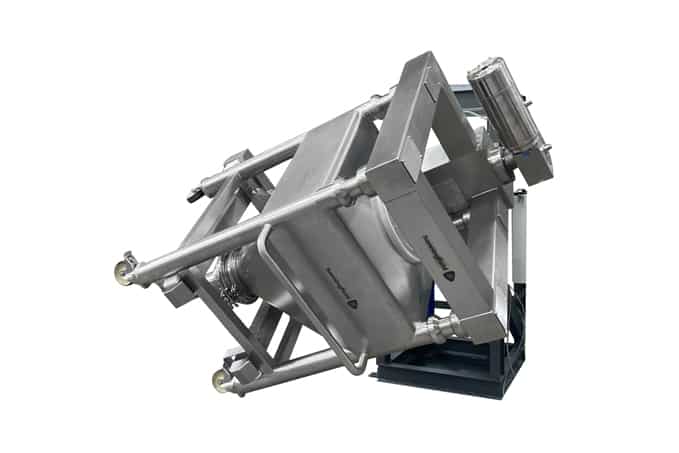
To select a pharmaceutical IBC blender, define the powder blend, smallest and largest batch, usable container volume, loaded weight and production layout. Then specify how the bin will be filled, blended, moved, discharged and cleaned. The right configuration must suit the complete batch journey.
An intermediate bulk container (IBC) blender mixes material inside the container that holds it. Hanningfield’s Uni-Blend bin blenders gently tumble IBCs and drums, with different container volumes accommodated on a single blender where specified. This flexibility makes the container and its interfaces central to selection.
Start with the blend and the required result
Describe the ingredients, their proportions and relevant powder characteristics. Include bulk density, particle size information, moisture sensitivity, flow behaviour and any tendency to agglomerate.
Set out what a successful blend must achieve and how it will be assessed. Agree the sampling approach, blend uniformity criteria and any limits on changes to product characteristics. A batch that fits inside a container still needs a suitable blending process.
For multiple formulations, provide the range of materials and batch sizes. Identify which combinations need investigation rather than assuming that one successful recipe establishes performance for every product.
Separate batch mass, working volume and load
Container capacity is expressed in litres; production requirements are often expressed in kilograms. Translate between them using the powder’s bulk density, then establish the permitted working volume for the formulation and container.
As an illustrative calculation, 250 kg of powder at a bulk density of 0.5 kg/L occupies approximately 500 litres. This describes powder volume, not a recommended IBC size. The supplier must also establish the space needed for blending and the permitted operating fill range.
- Batch mass: Smallest, typical and largest batch in kilograms.
- Working volume: Permitted powder volume for each product and IBC combination.
- Loaded weight: Container, product and attached components within the specified load limit.
- Container range: Which bin sizes and geometries the proposed blender accepts.
Specify the minimum batch as carefully as the maximum. A flexible installation needs a workable plan for small production runs as well as its largest campaign.
Check container compatibility and discharge
For an existing IBC fleet, supply drawings, dimensions, empty weights, lifting features and outlet details. Compatibility includes how the bin is secured and supported, alongside its nominal volume.
Hanningfield supplies stainless steel IBCs with application-specific designs and outlet arrangements. Plan the outlet around the next process and the material’s discharge behaviour. Include requirements for seals, product-contact surfaces, inspection access and cleaning.
Map connections that operators will make and break. A closed bin can reduce open handling, but the complete filling and discharge arrangement determines how the material is contained during those tasks.
Choose the configuration around the room
Uni-Blend configurations include pedestal, through-the-wall and post-hoist-mounted arrangements. Compare them using a dimensioned layout showing the bin’s full movement, operator access and maintenance space.
- For a pedestal arrangement, establish the operating footprint and route for presenting and removing bins.
- For a through-the-wall arrangement, define the wall interface and access requirements on both sides.
- For a post-hoist arrangement, define the lifting and positioning duties as well as the blending duty.
Include doors, ceiling restrictions, docking heights and the route to downstream machinery. Hanningfield’s system integration examples show how IBC handling can connect blending with milling and process-machine loading.
Calculate capacity across the full batch cycle
Blending time alone does not define daily output. Record the time for bin presentation, securing, blending, removal and preparing the next batch. Separately map filling, discharge, washing, drying and release for reuse.
Charging and discharging can take place offline with an IBC system. The practical benefit depends on having enough suitable bins and capacity at those other stations. Identify whether the blender, washing area or downstream process limits the schedule before specifying more equipment.
Define controls and evidence before ordering
List the recipes, operator permissions and batch records your process requires. State the necessary control functions and agree the documentation and testing scope with the supplier.
Acceptance criteria should cover the intended container range, operating sequence, blend performance and relevant interfaces. Use defined product and batch conditions so the agreed result is measurable.
Hanningfield supports international projects from its UK headquarters, with a US location and regional sales support in Asia-Pacific and for Germany, Austria and Switzerland. Find your regional contact, or meet our DACH sales manager.
Ready to specify an IBC blending system? Contact Hanningfield with your batch range, material details, container drawings and room layout to discuss a Uni-Blend configuration for your process.