

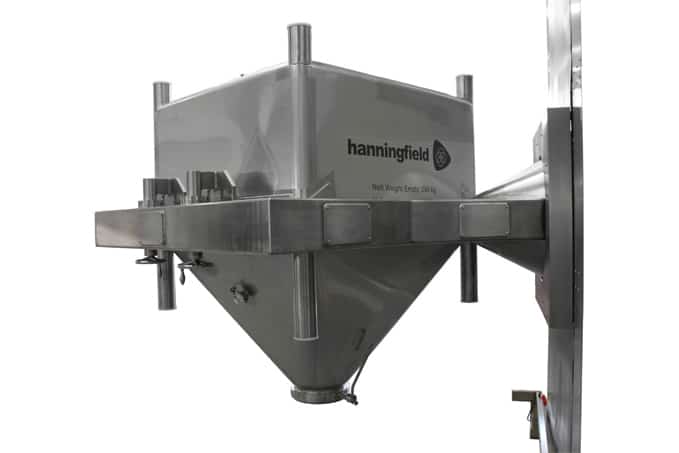
Revolutionise Your Blend: Why IBC Blenders Outshine Traditional Methods
In the demanding worlds of pharmaceutical and nutraceutical production, achieving a homogenous and consistent powder blend is not just good practice, it’s critical for product efficacy, safety, and regulatory compliance. For years, various blending methods have been employed, but increasingly, manufacturers are turning to a more advanced and efficient solution: the Intermediate Bulk container (IBC) Blender.
If you’re still relying on traditional blending techniques, you may be missing out on significant advantages. Let’s explore why IBC blenders are revolutionising the powder blending process and discuss the huge benefits this may offer over older methods.
The Challenges With Traditional Blending Methods
Before we explore the benefits of IBC Blending, it’s worth understanding the common hurdles faced with conventional blending equipment:
> Product Transfer Losses: Repeated transferring of material between different vessels (e.g. from a blending drum to a storage bin) inevitably leads to product loss, dust generation, and potential cross-contamination.
> Cleaning Downtime: Cleaning traditional blenders can be a time-consuming and labour-intensive process, especially when dealing with multiple product changeovers. This directly impacts overall production efficiency.
> Limited Flexibility: Many traditional blenders are fixed in place, limiting their adaptability to different batch sizes or product types without significant retooling.
> Segregation Risk: during transfer steps, there’s an increased risk of particle segregation, undoing the homogeneity achieved during blending.
> Operator Exposure: More open handling of powders can lead to increasing operator exposure to active pharmaceutical ingredients (APIs) or other fines.
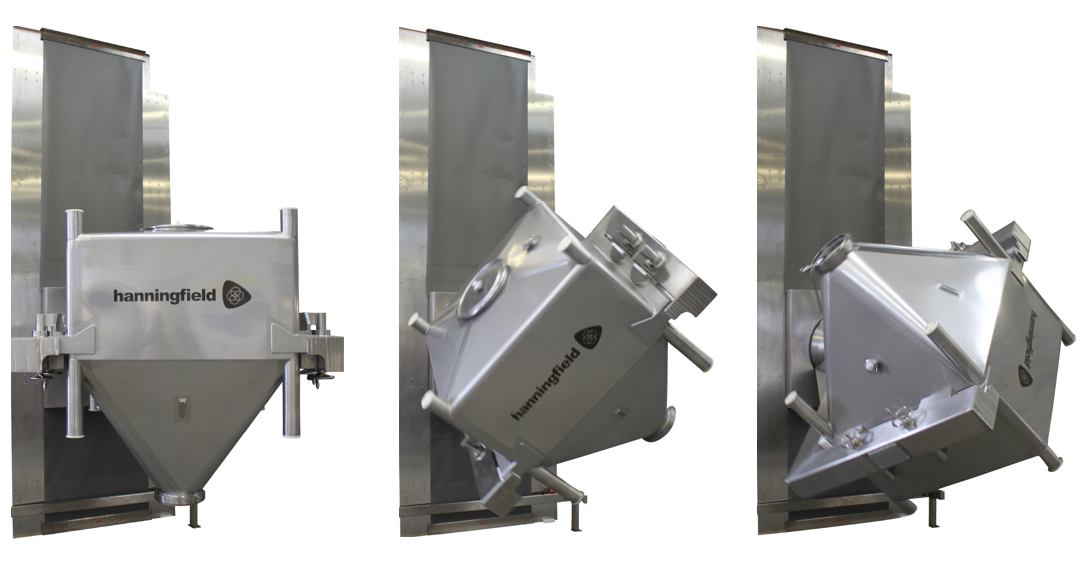
The IBC Blender Advantage
An IBC Blender at its core is a blending system whereby the mixing action occurs directly within a sealed IBC. The IBC itself acts as the blending vessel, eliminating the need for product transfer in and out of a separate blender. This fundamental difference unlocks a cascade of benefits:
> Reduced Product loss & Contamination: This is perhaps the most significant advantage. By blending directly within the IBC, there’s no need to transfer powders to and from a dedicated blender. This dramatically reduces material loss, minimise dust generation, and virtually eliminates the risk of cross-contamination between batches or products.
> Faster Changeovers & Increased Throughput: With traditional blenders, extensive cleaning is required between different product runs. with an IBC Blender, you simply detatch one IBC and attach another. Cleaning is primarily focused on the IBCs themselves, which can be done offline, leading to significantly reduced downtime and much faster product changeovers. This results in increased production capacity.
> Enhanced Homogeneity & Consistency: IBC Blenders are designed to provide highly efficient and thorough mixing. The sealed environment and controlled rotation ensure that even complex multi-component blends achieve excellent homogeneity, leading to consistent product quality from batch to batch.
> Improved Operator Safety: Since blending occurs within a sealed container, operator exposure to powders is greatly reduced. This is particularly crucial when handling potent APIs or allergenic materials, enhancing workplace safety and reducing the need for extensive PPE to be worn.
> Greater Flexibility & Scalability: IBC Blenders offer exceptional flexibility. You can use different sized IBCs on the same blending unit, accommodating various batch sizes without the need for multiple blenders. This scalability makes them ideal for both small scale R&D and large scale production.
> Simplified Validation & Cleaning Validation: the enclosed nature of the IBC blending process simplifies validation efforts, particularly for cleaning validation, as there are fewer contact surfaces and less potential for residue build-up.
> Optimised Space Utilisation: Compared to fixed blenders that often require dedicated processing rooms, IBC Blenders can offer a more modular and space-efficient solution, as the blending unit itself has a smaller footprint.
Is An IBC Blender Right For Your Operation?
If your production involves:
- Frequent product changeovers
- High-value or potent ingredients
- A strong emphasis on reducing cross-contamination
- The need for consistent and homogeneous blends
- A desire to improve operational efficiency and safety
…then an IBC Blender is certainly worth serious consideration. The initial investment may be slightly higher than some traditional blending methods, but the long-term savings in product loss, cleaning time, labour costs, and improved product quality often provide a rapid return on investment.
In conclusion, employing an IBC Blending system isn’t simply an upgrade, it’s a strategic move towards a more efficient, safer, and higher quality production process.
Get in Touch
If you would like to speak to one of our experts regarding your IBC Blender application or you would like a quote for one of our products, send us a message using our Contact Form or call us on +44 (0)1702 549 777.
To keep up-to-date with the latest news from Hanningfield you can follow us on LinkedIn.